


In the dynamic and global filtration industry, news and information is breaking on a daily basis. International Filtration News is tracking stories relevant to our industry from air and gas filtration to liquid filtration and the various end-uses for filtration technology. Here we will post news stories relevant to filtration and its downstream applications on an ongoing basis. Please check back for regular updates. If you have news that you feel should be added to this summary report, please email it to Ken Norberg: ken@filtnews.com
Most recent update: April 02, 2026
Atmus Opens Expanded Testing Laboratory at Quimper, France Site
Atmus Filtration Technologies Inc., a global leader in filtration and media solutions, has opened a new state-of-the-art laboratory facility at its Quimper, France, location, reinforcing the company’s commitment to advancing filtration technology and reducing testing lead times for customers.
The modernized testing facility strengthens Atmus’ global laboratory network, resulting in an experience that better supports its customers and positions the company to meet future needs. By enhancing the European infrastructure, testing that previously required support from other global sites will now be performed locally, improving speed, flexibility and coordination within Atmus’ global testing network.
Designed as a modern, purpose-built environment, the facility provides the right foundation to enable future testing capabilities, including multivariate testing that more accurately simulates real-world operating conditions. With upgraded infrastructure, Atmus can conduct more comprehensive validation testing to meet the requirements of original equipment manufacturer (OEM) specifications.
The Quimper laboratory is certified to automotive IATF 16949 and laboratory ISO 17025 standards and conducts more than 5,000 filter tests annually, supporting both liquid and air or aerosol applications.
The facility is one of five Atmus testing laboratories worldwide that operate as “One Global Lab,” enabling collaboration and shared expertise across locations. Performing testing closer to the customer also helps reduce the need for inter-site shipping and travel, supporting Atmus’ environmental commitment by lowering associated carbon impacts. Other Atmus laboratories are located in Pune, India, and Wuhan, China, as well as Cookeville, Tenn. and Stoughton, Wisc., in the United States.
Metso appoints Jonathan Allen as Chief Growth Officer
Jonathan Allen has been appointed Metso’s Chief Growth Officer as of May 1, 2026, responsible for the Business Growth function consisting of Strategy, Mergers & Acquisitions, AI, Data & Analytics, Sustainability, Safety, Quality, Communications & Public Affairs, Marketing & Brand and Corporate Procurement. He will be member of the Metso Leadership team and will report to President and CEO Sami Takaluoma. Jonathan succeeds Claudia Genin who will leave Metso latest by August 2026 as previously announced.
Jonathan joined Metso in 2005 and has most recently held the role of Senior Vice President, Grinding, Bulk, Pyro & Smelting business line and is part of the Services business area leadership team. During his over 20 years at Metso, he has held several leadership positions in France and USA. He has a bachelor’s degree in mechanical engineering from Penn State University, USA.
Focus on Nonwovens for Filter Media
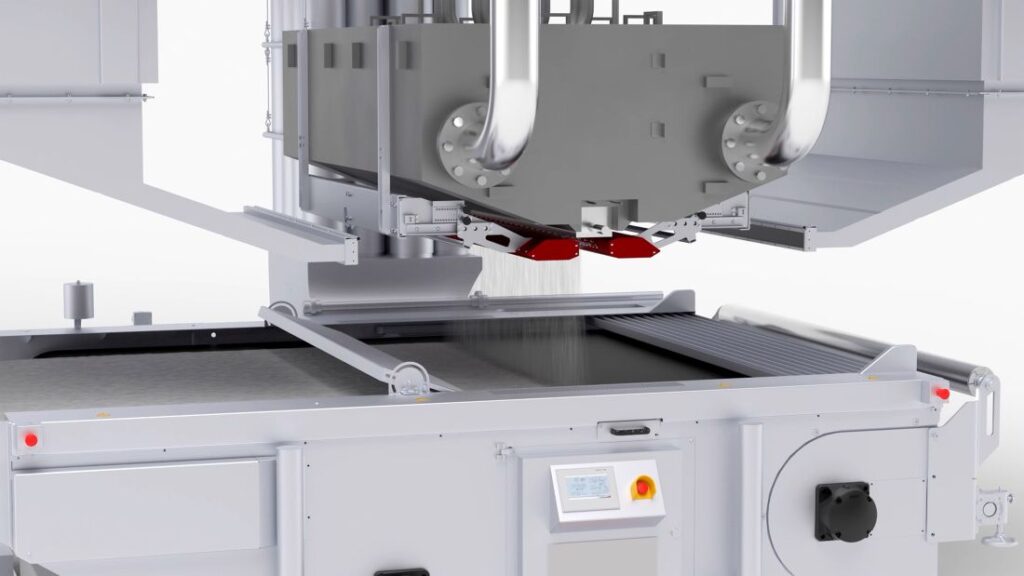
Under its Neumag brand, Barmag will present its technologies for the production of nonwovens for filter media at this year’s FILTECH. From June 30 to July 2, the company will be represented at the Cologne trade fair in Hall 8, Booth E68.
The main focus is on solutions for producing high-performance filter media at competitive costs. Here, Neumag excels in both the meltblown sector and with its spunbond solutions.
Neumag’s meltblown technology enables the efficient and straightforward production of high-performance nonwovens for filtration, insulation, and sorption applications. A wide variety of polymers can be processed—from classic polyolefins such as PP and PE, through PET, PLA, PBT, and PA, to specialty plastics like PPS or TPU. All of these and other raw materials can be processed safely and reliably using the Neumag meltblown process.
The hycuTEC hydrocharging technology, which was honored with the Edana Filtrex Innovation Award, enables the production of particularly high-performance electret filter media. This allows the pressure drop of a typical FFP2 filter medium to be reduced to less than a quarter. “Filtration efficiencies of over 99.99% are easily achievable with standard media weighing around 35 g/m² and a maximum pressure drop of 35 Pa,” explains Andreas Frisch, Regional Sales Director Nonwoven. “Furthermore, the additional drying step is eliminated in most applications—another advantage of this innovative technology,” he adds.
Spunbond nonwovens are becoming increasingly important in filtration—both as carrier materials and as standalone filter media. By tailoring nonwoven structures specifically to the task at hand, customer-specific requirements can be precisely met. It is also possible to combine multiple functions within a single layer.
In particular, the company’s long-standing expertise in bicomponent spinning processes opens up new possibilities in the design of innovative nonwoven structures. The Neumag Bico spunbond process allows for the combination of different fiber cross-sections as well as the simultaneous production of different fibers from one or more polymers on a single line. The spectrum ranges from classic core-sheath and side-by-side filaments to split fibers and so-called mixed fibers.
Kemira Completes Full-Scale US Trial of Chlorine-Free Wastewater Treatment
Kemira, a global leader in sustainable chemical solutions for water-intensive industries, announced that it has successfully completed the first US full-scale trial of its chlorine-free wastewater treatment technology, KemConnect® DEX, with Capital Region Water, the advanced wastewater treatment facility serving the city of Harrisburg, Pennsylvania and surrounding municipalities. This milestone was achieved in just eight months after the core ingredient of DEX was registered with the Environmental Protection Agency (EPA) for commercial use in the US.
The KemConnect DEX solution is uniquely based on performic acid, a fast-acting, sustainable alternative to traditional chlorine-based microbial control. Results from the one-month full-scale trial demonstrate that even at low doses, Kemira’s performic acid-based solution quickly reduces bacteria levels and rapidly auto-degrades into readily biodegradable compounds, which exhibit low environmental persistence- thereby improving water quality, while minimizing environmental impact.
The technology behind KemConnect DEX automates treatment dosing based on real-time data, with flexible feed-rate capabilities that enable operators to consistently meet required bacterial limits despite weather-driven fluctuations in flow and water quality. The DEX technology platform is also installed on-site, enabling facilities to modernize their infrastructure without the considerable costs and investment often required by many chlorine-based solutions and UV treatment alternatives.