

The original article was prepared for the International Fiber Journal, where it addresses the nonwovens industry broadly, as this is the main goal from an EDANA perspective. In this version, I expand the discussion to focus specifically on implications for the filtration industry. In many filtration applications, nonwovens serve as the functional basis for composite media and can materially influence final filtration performance. This has direct consequences for the filtration and supply chains. There’s an overlap.
A further reason for this deeper focus is the clear distinction between durable nonwovens and single-use applications. The Forum discussions underlined that there is no single solution applicable across all product categories; rather, meaningful progress depends on segmentation, context-specific tradeoffs, and application-led strategies.
Accordingly, I will address several topics in greater detail and outline what they may imply for the filtration sector. The conclusions are therefore primarily framed for filtration stakeholders. I hope you find this a valuable read.
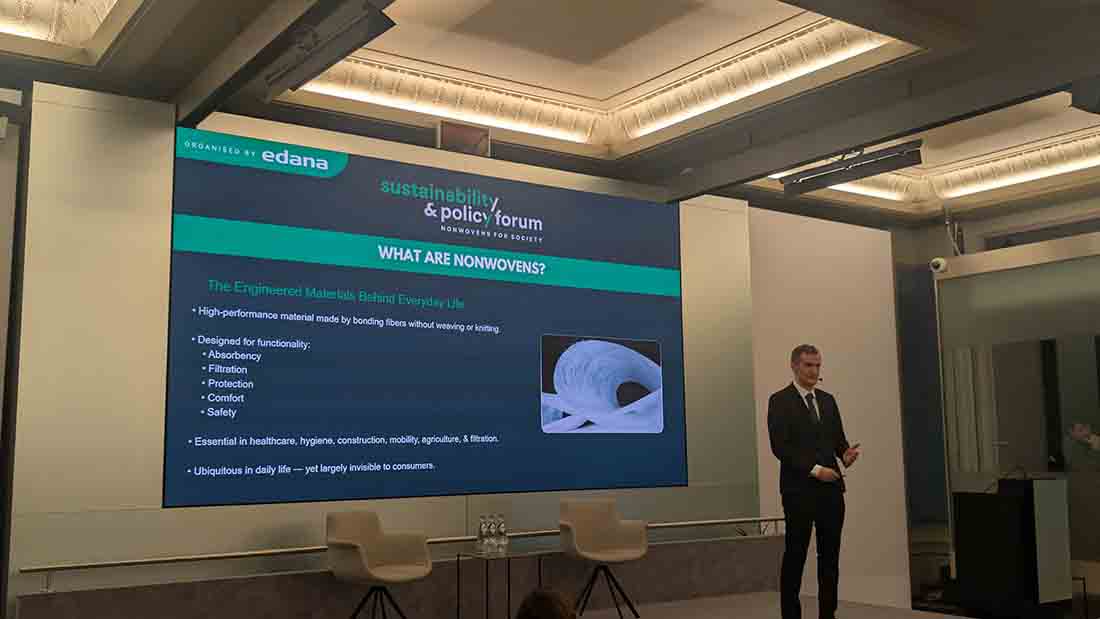
EDANA’s Sustainability and Policy Forum in Brussels
EDANA’s Sustainability & Policy Forum in Brussels (Dec. 9–10, 2025) combined plenaries, an EU advo-
cacy workshop, and a visit to the European Commission. Topics ranged from sustainability priorities to operational issues like disclosure, CSRD as a management tool, and product metrics such as Carbon Footprint and LCA.
Circularity was key, with panels emphasizing that it won’t be achieved in silos and questioning how textiles and nonwovens can collaborate amidst evolving regulations and infrastructure.
Day 1 focused on enabling routes, chemical recycling, and policy impact, while Day 2 explored EU policy formulation. There were interactive workshops on turning circularity goals into actionable rules without compromising safety and performance.
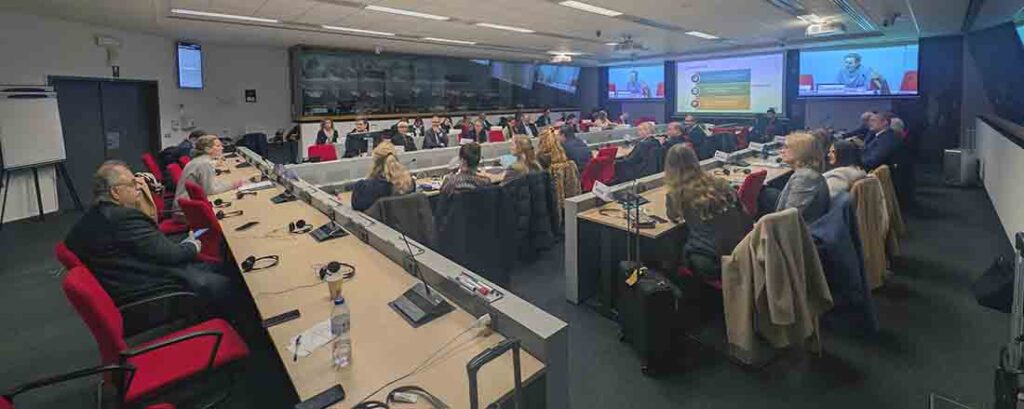
The European Commission discussions covered operations, the Waste Framework Directive, and environmental policy. EDANA highlighted the importance of strategic dialogue beyond compliance, encouraging collaboration across the nonwovens chain. Sessions underscored the need for collective action, anticipating future trends to reconcile regulatory demands with practical needs in hygiene and safety. This signals a shift from merely reporting sustainability data to actively managing it, aiming for credible, actionable outcomes in nonwovens.
What EDANA Aimed to Achieve
EDANA describes the Forum as a space where industry, policymakers, experts, and stakeholders can step back from daily regulatory pressures and engage in strategic, forward-looking discussions. Its purpose extends beyond sharing information: it is designed to foster dialogue across the value chain, identify emerging trends early, and support a more coordinated and credible industry response to sustainability and policy challenges.
In EDANA’s view, the format was effective: participation, diversity of viewpoints, and the quality of exchanges, particularly on regulation and circularity during the advocacy workshops, confirmed the Forum’s relevance. The real test, EDANA notes, is translating this into action: turning the exchanges into tangible follow-up work in the months ahead.
Common Themes Across Presentations and Discussions
- Practical implementation within regulatory simplification
A key focus was advancing circularity alongside regulatory simplification. The workshop shifted the debate from whether circularity matters to how product policy can operationalize it for nonwovens manufacturers. Participants stressed that processes, safety, and performance are non-negotiable and must be embedded in regulation. This supports proportionate, application-specific regulation that integrates essential criteria into the framework, especially for hygiene, medical and technical products (including filtration), instead of treating them as secondary. - Advancing from reporting to strategic sustainability management
A key theme was shifting from sustainability reporting as an end to sustainability management as a core discipline. Highlight CSRD as a strategic tool, given organizations invest in data infrastructure and build resilience for EU requirements. The overlap of regulatory instruments adds complexity, requiring internal alignment. Practically, sustainability teams now need to adopt finance-like approaches: data governance, controls, accountability, and decision-useful outputs to support prioritization and performance, rather than just narrative disclosures. VSME (stands for the Voluntary Sustainability Reporting Standard for non-listed SMEs) was briefly discussed. - Driving systems-level circularity through collaboration
Systems-level circularity became a priority, emphasizing the need for deeper collaboration across textiles and nonwovens, and even polymer suppliers in general. Discussions focused on reducing barriers, sharing opportunities, and turning ambitions into scalable actions. While progress in chemical recycling and mass balance is evident, their adoption needs policy support and clear regulations. Clear definitions, consistent interpretation, and legal validation are essential for investment and market growth. - Emphasizing credibility and transparency
Throughout the sessions, credibility and trust were key themes, with speakers emphasizing that credible communication depends on transparency, traceable evidence, and data-driven commitments that withstand scrutiny from regulators, customers, and stakeholders. The discussions reflected the industry’s pragmatic, science-based approach, stressing informed decision-making and reliable data as fundamentals for progress. Ultimately, the Forum confirmed that credibility is a performance outcome achieved through governance, evidence, and transparency, vital for maintaining trust and advancing the industry’s sustainability journey.
Focus Topics and Filtration Implications
Common themes from the Forum:
- Circularity and enabling policy frameworks: Focus on practical cross-sector cooperation, circularity routes (including chemical recycling where relevant), and the need for clear policy frameworks and legal recognition to make these routes implementable.
- Reporting as a business tool (CSRD, ESRS and related disclosures): Reporting was positioned as a strategic management instrument, emphasizing strong data foundations and data-driven commitments.
- Product-level evidence for durable nonwovens (PCF/LCA/EPD): A clear push toward customer-relevant metrics and product-level evidence, notably via Product Carbon Footprint and Life Cycle Assessment.
- Supply security and resilience: Supply security was flagged as a constraint during transformation, requiring companies to balance adaptation, innovation, competitiveness, and supply stability; reporting was also linked to operational and supply-chain resilience.
- Credibility, transparency, and claims: While “greenwashing” was not explicitly addressed, the underlying emphasis was on credibility, transparency, and evidence-based claims.
- Single-Use Plastics Directive: Referenced as a policy tool supporting reuse, collection, and recycling systems, but without detailed timing or dedicated coverage in the program.
Filtration-Specific Implications
- Performance remains non-negotiable: Circularity objectives must align with qualification requirements, safety standards, and functional performance expectations typical of regulated filtration applications.
- Data pressure is multi-directional: Filtration value chains are increasingly pulled by simultaneous data requests from customers, regulators, and corporate reporting teams, creating a clear need for interoperability across frameworks and internal systems.
- Policy must be implementable across the whole supply chain: Circularity rules must work in practice without undermining process stability, safety, or product performance, particularly where change control and requalification are costly and time-consuming.
- Proportionality matters: Filtration must be treated as a distinct, performance-critical application area; “one-size-fits-all” approaches risk missing technical realities and societal needs.
- PCF/LCA/EPD are becoming decision tools: Comparable product-level evidence will increasingly influence supplier evaluation, purchasing decisions, and customers’ ability to meet their own reporting obligations.
Forum Takeaways
The materials do not describe any formal communiqué or new commitment from the Forum. The primary outcome is EDANA’s positioning of the event as a platform for constructive debate, with success measured by follow-up actions. Workshop questions remain how to make circularity goals into practical policy without sacrificing hygiene and performance, how industry can influence Commission drafting, and how inter-departmental dynamics affect decisions. For nonwovens, these issues impact compliance and innovation. EDANA notes the difficulty of keeping up with evolving regulations and ensuring innovation and supply security. It stresses that one-size-fits-all rules risk overlooking technical and societal differences across nonwoven applications, underscoring the need for segmentation for both advocacy and strategy.

Rawaa Ammar, Sustainability Director from EDANA said: “This year’s Sustainability & Policy Forum brought together an exceptional mix of insights, exchanges and forward-looking discussions. The sessions were rich and thought-provoking, exactly the kind of space we aim to create to network and co-develop ideas, stay up to date with the latest regulatory and market developments, and spark new reflections for the industry. The true impact of the event will unfold in the months ahead, and I am keen to channel the valuable conversations we had into tangible projects that can strengthen the industry’s sustainability journey. As the new Sustainability Director, my focus is on building on this strong foundation and helping our sector accelerate credible, science-based action on climate, circularity and responsible value chains.”
Personal Conclusions and Perspectives from a Filtration Perspective
From a filtration perspective, this is where the “policy–data–performance” triangle becomes unavoidable. In our value chain, the sustainability question is rarely limited to “Is it greener? Is it more sustainable?” Customers, regulators, and auditors increasingly ask the harder follow-up: does it still perform, is it demonstrably safe, and can you prove both with evidence rather than statements?
This reality reshapes what “good” looks like for circularity and reporting in filtration. Whether a filter is used in HVAC, cabin air, industrial dust collection, liquid filtration, or coalescing, qualification cycles are typically long, and the tolerance for unintended performance drift is low. Against that backdrop, the Forum’s emphasis on product-level proof (PCF/LCA/EPD) and on policy approaches that do not compromise performance is not simply relevant; it is essential to maintain market acceptance and regulatory feasibility.
This leads to a practical recommendation. Filtration companies and associations should treat measurement, qualification-ready testing, and policy engagement as strategic capabilities alongside supply security. Supply continuity is not a background issue in filtration; it is a design constraint. If regulations and customer expectations accelerate material and design changes, the winners will be those who can manage transition plans that protect availability, quality consistency, and compliance evidence while still progressing on circularity.
My view is that filtration also holds an underused strategic advantage: it plays a dual role. The sector must improve the circularity of its own products, but it also enables circularity elsewhere by making resource recovery, cleaner processing, and emissions control technically possible. If we articulate that “enabler” role with credible data, filtration can move from being perceived as a compliance-heavy industrial input to being recognized as sustainability infrastructure.