


Houston-based Rice University researchers have unveiled a copper-aluminum material that absorbs per- and polyfluoroalkyl substances (PFAS) — so-called “forever chemicals” — at speeds that make current filtration methods look ancient. The research, recently published in Advanced Materials, marks a major step toward addressing one of the world’s most persistent environmental concerns.
The study was led by Youngkun Chung, a postdoctoral fellow under the mentorship of Michael S. Wong, a professor at Rice’s George R. Brown School of Engineering and Computing, and conducted in collaboration with Seoktae Kang, professor at the Korea Advanced Institute of Science and Technology (KAIST), and Keon-Ham Kim, professor at Pukyung National University in South Korea.
The breakthrough centers around a layered double hydroxide (LDH) compound that doesn’t just trap PFAS faster than anything on the market but actually destroys them. While commercial carbon filters struggle to remove these pollutants, this new material that combines copper and aluminum with nitrate
captures them about 100 times faster than commercial carbon filters.
“This LDH compound captured PFAS more than 1,000 times better than other materials,” Chung said. “It also worked incredibly fast, removing large amounts of PFAS within minutes, about 100 times faster than commercial carbon filters.”
The material’s unique structure emerges from layers of copper and aluminum with a slight imbalance in their charge, sucking in perfluorooctanoic (PFOA) molecules, which bind tightly with the filter.
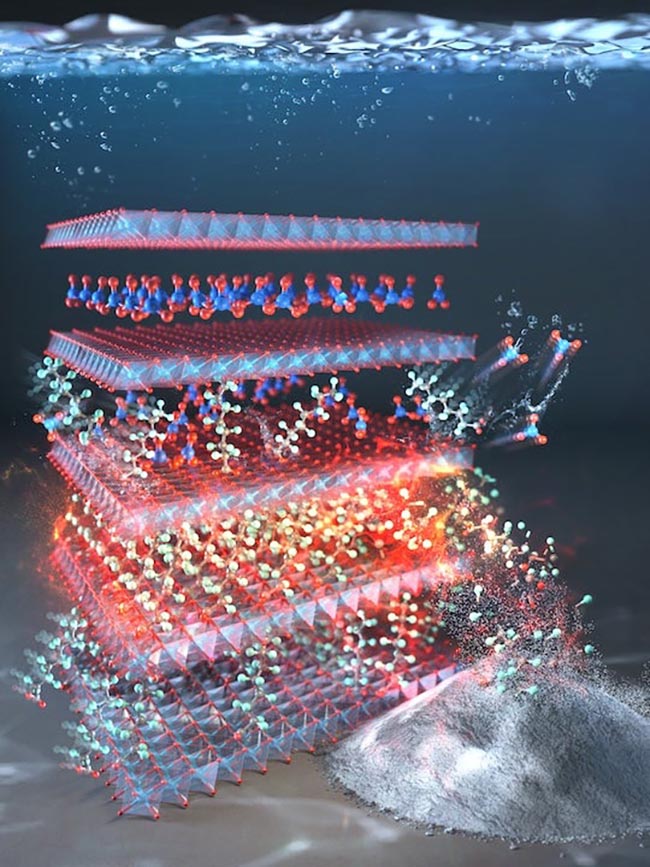
Once the adsorption material was saturated with PFOA, the team heated the material and added calcium carbonate, which allowed them to “clean” the LDH for reuse and strip the PFOA of its fluorine backbone, effectively destroying it.
The remaining fluorine-calcium material can be disposed into landfill safely, Rice engineer Wong told The Guardian.
Preliminary studies showed the material could complete at least six full cycles of capture, destruction and renewal, making it the first known eco-friendly, sustainable system for PFAS removal.
The importance of this is hard to underestimate. PFAS are a class of thousands of compounds used since the 1940s in everything from non-stick cookware to firefighting foam and stain resistant fabrics among others. These substances that are thought to be cancer-linked persist in the environment due to their incredibly strong carbon-fluorine bonds, earning them the nickname forever chemicals.
“This material is going to be important for the direction of research on PFAS destruction in general,” said Wong, who is also director of Rice’s WaTER Institute.
For the roughly 150 million Americans with potential PFAS-contaminated drinking water, this represents an important finding. It has the potential to actually eliminate these dangerous compounds instead of just moving them around. The Rice team is now working toward commercial pilots that could transform how municipal and industrial water treatment systems handle these persistent pollutants.