


Fibrous materials have long played a central role in providing clean air. When examining recorded air-cleaning inventions, one notable commonality stands out — the use of fibers. As early as 1848, U.S. Patent No. 6,529 was granted to Lewis P. Haslett for the Inhaler or Lung Protector, widely considered as the first modern respirator, which utilized porous woolen fabrics to filter harmful substances from inhaled air1. Later, in 1879, Hutson Hurd was awarded U.S. Patent Nos. 217,691 and 218,976 for an inhaler and respirator design featuring a cup-shaped mask made of sponge or cotton-wool filtration media to block dust and toxic gases, a form still echoed in the structure of modern respirators today2.
From these early innovations to today’s advanced HEPA systems, air media technologies have evolved rapidly in response to increasing air pollution concerns, airborne disease transmission, and indoor air quality. At the center of this progress, fiber science has had a deep impact. Over the past century, breakthroughs in material science, fiber and web formations, equipment advancements, web consolidation improvements, and polymer science have transformed filtration from a basic mechanical barrier into highly sophisticated technologies.
This evolution has followed multiple technological pathways in parallel. Traditional fibrous materials such as cellulose and fiberglass laid the groundwork for early air filtration media technologies, while modern advancements, ranging from polymer innovations such as isotactic polypropylene to nanofibers and electrostatically charged materials, have pushed the boundaries of filtration science. As filtration applications broadened — from personal protective equipment to data centers — so did the requirements for thermal stability, chemical resistance, and fine particle retention.
Five key categories of filter media technologies have defined the trajectory of air filtration — expanded polytetrafluoroethylene (ePTFE) membranes, electrospun nanofiber coatings, electrostatic (electret) media, glass fiber media, and synthetic nonwoven materials. Below, each category is analyzed through its historical recorded milestones via key patents, performance characteristics and current
applications.
Advances in fiber formation and post-processing techniques, equipment innovations, emerging biopolymers, modeling and simulation support, and artificial intelligence-assisted material design promise to accelerate the development of unique filter media for tailored needs.
ePTFE Membranes
The path to expanded ePTFE membranes in filtration begins with the serendipitous discovery of PTFE itself. In 1938, DuPont chemist Roy J. Plunkett experimented with tetrafluoroethylene gas in pursuit of safer refrigerants. He discovered that the gas was polymerized into a waxy white solid inside a pressurized cylinder. This new polymer was later patented as PTFE — U.S. Patent No. 2,230,654 — and quickly drew attention for its chemical inertness, low friction and electrical insulation3.
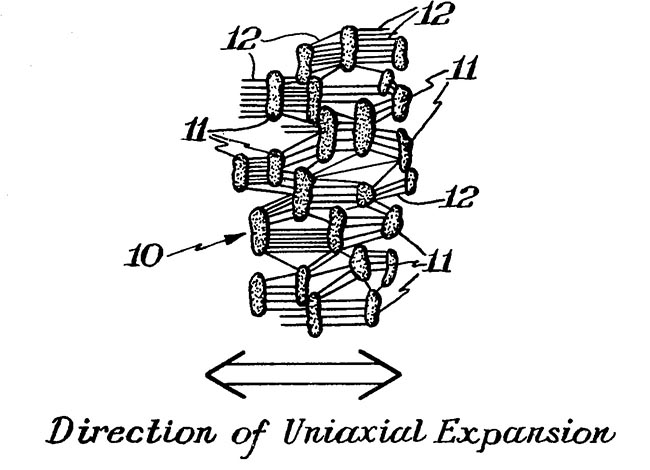
While PTFE became widely used in coatings, seals and wire insulation, its potential expanded exponentially when Robert W. Gore discovered a way to stretch it mechanically under specific conditions. This process created a microporous structure with nodes and fibrils now known as ePTFE, which was patented in 1976 — U.S. Patent No. 3,953,5663. The resulting fibrillated membrane could repel liquids while remaining gas-permeable, leading to its adoption in outdoor textiles, medical devices and later in air filtration.
For filtration applications, ePTFE membranes are generally laminated onto supporting substrates to produce composite media characterized by surface filtration behavior. Its stable pore structure supports long service life and efficient dust release during pulse cleaning, making it a highly effective solution in niche applications such as baghouse filters and industrial dust collectors, as well as high-efficiency particulate air (HEPA)/ultra-low particulate air (ULPA), cleanroom, pharmaceutical, and other critical air filtration systems where durability and stable performance are required.
Nanofiber Membranes
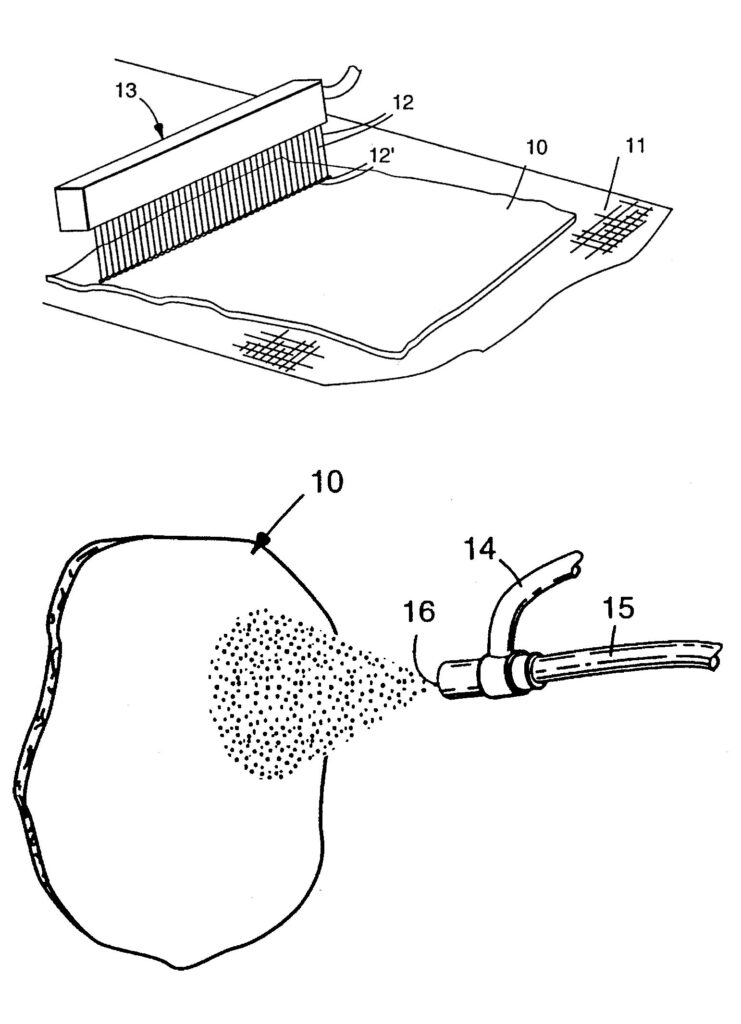
Electrospun nanofibers originate in the early 20th century. In 1900, John F. Cooley filed British Patent No. 6,385, describing a method for producing fine fibers using electrostatic forces, one of the earliest disclosures of what is now known as electrospinning. In 1934, Anton Formhals refined the technique and patented the electrospinning of cellulose acetate — U.S. Patent No. 1,975,5044. Despite these early demonstrations, the technology languished for decades due to limited commercial interest. It wasn’t until the 1990s that Jayesh Doshi and Darrell H. Reneker reignited interest in electrospinning through academic research. Their work with polyethylene oxide solutions opened new possibilities in tissue engineering and potentially in air filtration5. By the early 2000s, Donaldson Co. Inc., Bloomington, Minn., leveraged the prior art to develop commercial nanofiber-coated filter media, supported by a robust intellectual property portfolio starting with U.S. Patent No. 6,673,136 (2004)6. Since then, nanofiber-coated media has become widespread across the air filtration market.
Nanofibers are typically not used as standalone media. Instead, nanofibers, often less than 1 micrometer (µm) in diameter, are deposited onto supporting substrates, creating a surface filtration layer. They achieve even higher efficiency through the “slip flow” effect, where the fiber diameter is smaller than the mean free path of air molecules. Today, such media are used in minimum efficiency reporting values (MERV) 11-16 heating, ventilation and air conditioning (HVAC) filters, gas turbine intake systems, cabin air filtration, and dust collectors. Their primarily mechanical mode of filtration is a necessity, especially in commercial and industrial applications.
Electrostatic Filter Media
Electrostatic filtration is rooted in the discovery of electrets, materials capable of holding quasi-permanent electric charges. While Michael Faraday laid out the theoretical groundwork, the first practical electret was demonstrated by Mototaro Eguchi in the early 20th century. Eguchi’s thermo-electrets, made from dielectric waxes, retained electric fields after thermal treatment, laying out the conceptual framework for future electret-based filter media7.
One of the earliest documented instances came in 1930, when Hansen was granted British Patent No. 384,052 for a triboelectric filter composed of wool and resin. This innovation marked the first use of frictional charging for particle capture8. By the 1980s, triboelectric effects were enhanced with the U.S. Patent No. 4,798,850 describing a nonwoven blend of modacrylic and polypropylene (PP) fibers.
The introduction of corona charging in the 1970s led to many novel air filtration products such as face masks. This method uses high-voltage electric fields to impart charges into polymeric fibers without altering their structure. An influential early patent in this field was British Patent No. 1,164,921, assigned to DuPont in 1969, which later opened the doors for modern N95 respirators and high-efficiency HVAC filters.
In the late 1990s, hydrocharging emerged as an environmentally friendly method for charge injection, enabling deeper charge penetration and higher charge density. This was initially disclosed in U.S. Patent No. 5,496,507 by 3M Corp. Since then, the technology has transformed and is now commercially available, including retrofitting onto existing meltblowing lines. Today, tribo, corona, and hydrocharged filter media are used in various applications such as N95/P95/FFP2/KF94 respirators, MERV 8-16 filters, and cabin air systems, offering higher initial filtration efficiency at low resistance.
Glass Fiber Media
Glass fibers represent one of the oldest and most trusted materials in air filtration. The story began in the 1930s with James Slayter and John Thomas who developed a method to create fine fibers from molten glass using steam/gas attenuation. This process was described in U.S. Patent No. 2,121,802 (1938) and later refined in U.S. Patent No. 2,133,2368, leading to the first commercial use of glass fibers in insulation and eventually in air filters.
Micro glass fiber media — typically made of borosilicate — became particularly important in HEPA and ULPA filtration during the mid-20th century. With the ability to constantly filter out particles as small as 0.3 µm with a greater than 99.97 percent removal efficiency throughout its lifetime, fiberglass media became a preferred choice in many applications such as nuclear power facilities. Despite the rise of synthetics, fiberglass remains irreplaceable in certain applications.
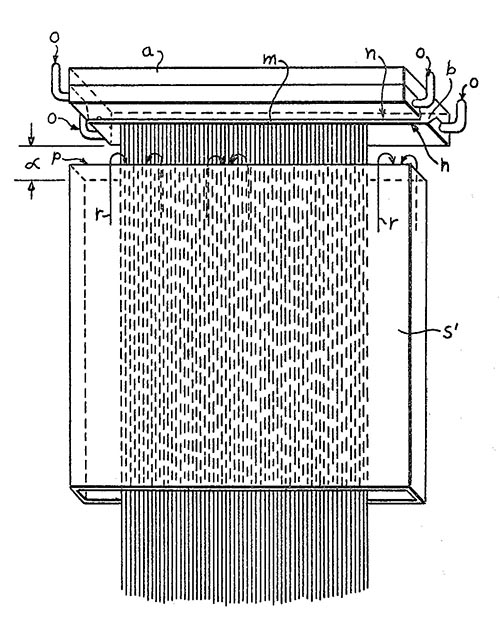
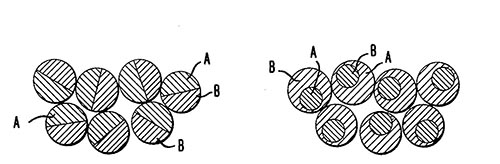
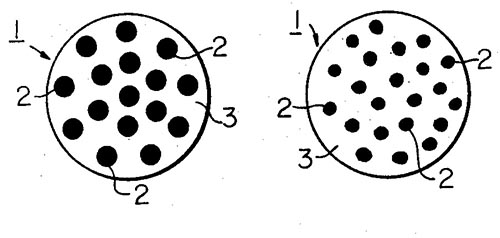
filamentary fiber from U.S. Patent No. 3,705,226.
Synthetic Media
The development of synthetic nonwoven media has been one of the most rapidly advancing areas in air filtration. The discovery of novel polymers after World War II significantly accelerated progress in this field. For example, in the early 1950s, the invention of high-density polyethylene (HDPE) and isotactic polypropylene (iPP), enabled by Ziegler-Natta catalyst technology, had a profound impact on filtration media development. In 1963, Karl Ziegler and Giulio Natta were awarded the Nobel Prize in Chemistry for their contributions to polymer chemistry; however, Phillips Petroleum was entitled to the iPP patent rights — U.S. Patent No. 2,794,842 — due to earlier documentation of the polymer and recognition of its utility in the United States. iPP is the dominant polymer used in meltblown and spunbond filtration media and thus forms the backbone of electrostatic filter media, including respirators and face masks. It is also worth noting the invention of polyethylene terephthalate (PET) in 1941 — British Patent No. 578,079; U.S. Patent No. 2,465,319 — which has likewise become a widely used polymer in filtration media applications.
Synthetic media can be broadly categorized by web consolidation methods such as thermobonded, needlepunched, spunlaced, and chemically bonded; and by fiber formation techniques such as meltspun and solution spun. Early synthetic media, often produced using wetlaid or drylaid processes with short-cut — frequently natural — fibers, were limited in their mechanical strength, durability and resistance to moisture.
The introduction of flash-spun (gel) webs, which was first described in U.S. Patent No. 3,081,519 in 1963, marked the birth of solution-spun nonwoven structures. However, their application in air filtration has remained limited10. On the other hand, the advent of spunmelt technologies revolutionized the field by enabling scalable production of filtering fabrics with controlled fiber diameter, web uniformity, and porosity for a wide range of applications.
Spunbonded fabrics, as a spunmelt technology, exhibit excellent tensile strength and dimensional stability. Early patents for this technology date back to the 1960s. For instance, in 1967, DuPont was awarded U.S. Patent No. 3,319,309 for spunbonding using electrostatic forces, allowing uniform fiber control. The following year, Germany-based Freudenberg secured U.S. Patent No. 3,379,811 which refined the process into a high-throughput, scalable solution for creating uniform and durable nonwovens. These spunbond fabrics now serve as respirator protective layers, pleat supports, cabin filters, and primary HVAC media in MERV 6-13 filters11.
The invention of meltblowing marked another leap. In 1974, ExxonMobil received U.S. Patent Nos. 3,825,380 and 3,849,241, introducing the first commercially viable meltblown process. By turning theory into practice, Exxon created a disruptive high-throughput single-step method for producing self-bonded, ultrafine webs — later combined with charging — ideal for MERV 11-16, cleanrooms and respirators12. Interestingly, the patent remains the most cited patent in the entire nonwoven or filtration space, underlining its widespread influence. Moreover, meltblowing patent landscape is still highly active, reflecting that the technology is still evolving, particularly in the die design and control of fiber formation.
The introduction of bicomponent synthetic fibers marked another milestone. While bicomponent filaments had already been explored in wet spinning technologies in the 1950s, the spunmelt industry quickly caught up as multiple melt-processable polymers were developed around the same time. In 1965, DuPont was awarded British Patent No. 994,336, covering early sheath/core and side-by-side spunmelt filament designs. This was followed by another important concept in 1972, when Japan-based Toray Industries received U.S. Patent No. 3,705,226 for sea-island bicomponent fibers, initially developed for synthetic leather applications. Since then, bicomponent fiber technology has enabled the production of inherently binder-free filter media with tailored porosity and mechanical strength. These materials are now widely used in many areas such as automotive cabin air filters and HVAC filters ranging from MERV 6-14, offering enhanced dust holding capacity and structural integrity without the need for chemical binders.

Future Outlook
The evolution of air filtration media is not just a record of material substitutions; it is a chronicle of applied research and industrial collaboration. Each breakthrough has contributed to layers of functionality, efficiency and reliability. In doing so, these functional fiber structures have enabled the creation of filters that are more efficient, stronger and more environmentally adaptive than ever before.
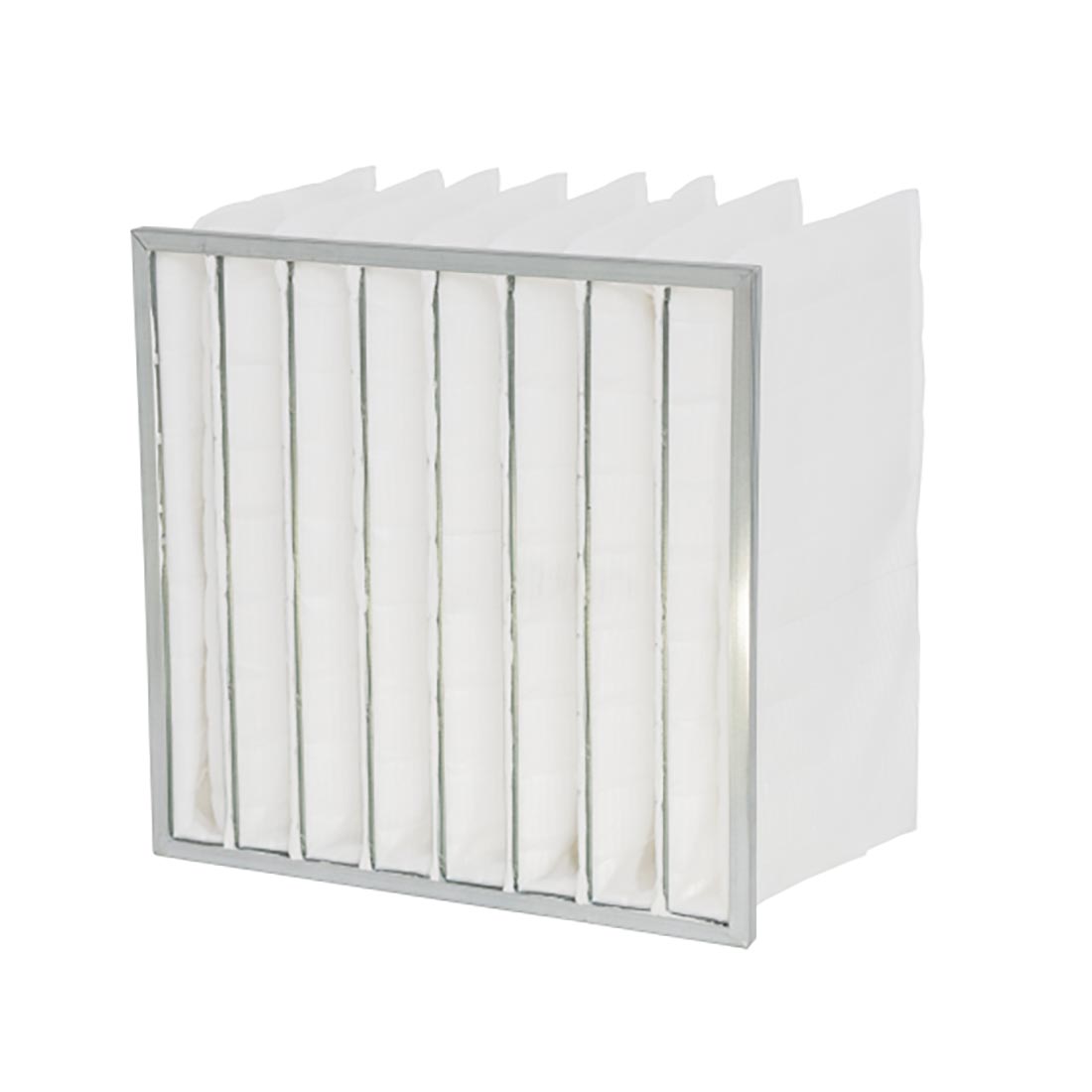
The megatrend of air quality is driving demand for functional fibers that go well beyond simple particle capture. Modern fibers can also contribute to removing harmful gases through adsorption, adding an extra layer of protection. Today, these fibrous materials are essential components of filter units. Advanced filtration fibers now serve as frontline defenses against a wide range of undesired contaminants in the air.
Looking ahead, the future of air filtration media is characterized by rapid innovation. Advances in fiber formation and post-processing techniques, equipment innovations, emerging biopolymers, modeling and simulation support, and artificial intelligence-assisted material design promise to accelerate the development of unique filter media for tailored needs.
Fibrous structures remain the most versatile and effective media for capturing airborne contaminants. As air filtration enters the age of smart and sustainable systems, these core fiber-based technologies will remain foundational, while cutting-edge technologies continue to evolve disruptively, addressing the rapidly changing challenges of clean air.
References:
- Sharma, N. M., & Chaudhary, A. R. (2020). Evolution of masks as public health intervention in the control of respiratory outbreaks. Natl J Community Med, 11, 138.
- Majchrzycka, K. (Ed.). (2020). Nanoaerosols, Air Filtering and Respiratory Protection: Science and Practice. CRC Press.
- Ebnesajjad, S. (2016). Expanded PTFE Applications Handbook: Technology, Manufacturing and Applications. Netherlands: William Andrew.
- Arinstein, A. (2017). Electrospun polymer nanofibers. Jenny Stanford Publishing.
- Doshi, J., & Reneker, D. H. (1995). Electrospinning process and applications of electrospun fibers. Journal of electrostatics, 35(2-3), 151-160.
- Ko, F. K. (2006). Nanofiber technology. Nanotubes and nanofibers, 233.
- Huiming, X., Gangjin, C., Xumin, C., & Zhi, C. (2017). A flexible electret membrane with persistent electrostatic effect and resistance to harsh environment for energy harvesting. Scientific reports, 7(1), 8443.
- Wang, C. S. (2001). Electrostatic forces in fibrous filters — a review. Powder Technology, 118(1-2), 166-170.
- Inductees of the National Inventors Hall of Fame. (2006). United States: National Inventors Hall of Fame Foundation, Incorporated.
- Handbook of Industrial Polyethylene and Technology: Definitive Guide to Manufacturing, Properties, Processing, Applications and Markets Set. (2017). United States: Wiley.
- Russell, S. J. (2022). Handbook of Nonwovens. United Kingdom: Elsevier Science.
- McCulloch, J. G. (1999). The history of the development of melt blowing technology. International Nonwovens Journal, (1), 1558925099OS-800123.