
Like a Fine Bordeaux Wine, WFC14 Delivered a Wide Variety of Complex and Bold Advancements to Congress Attendees
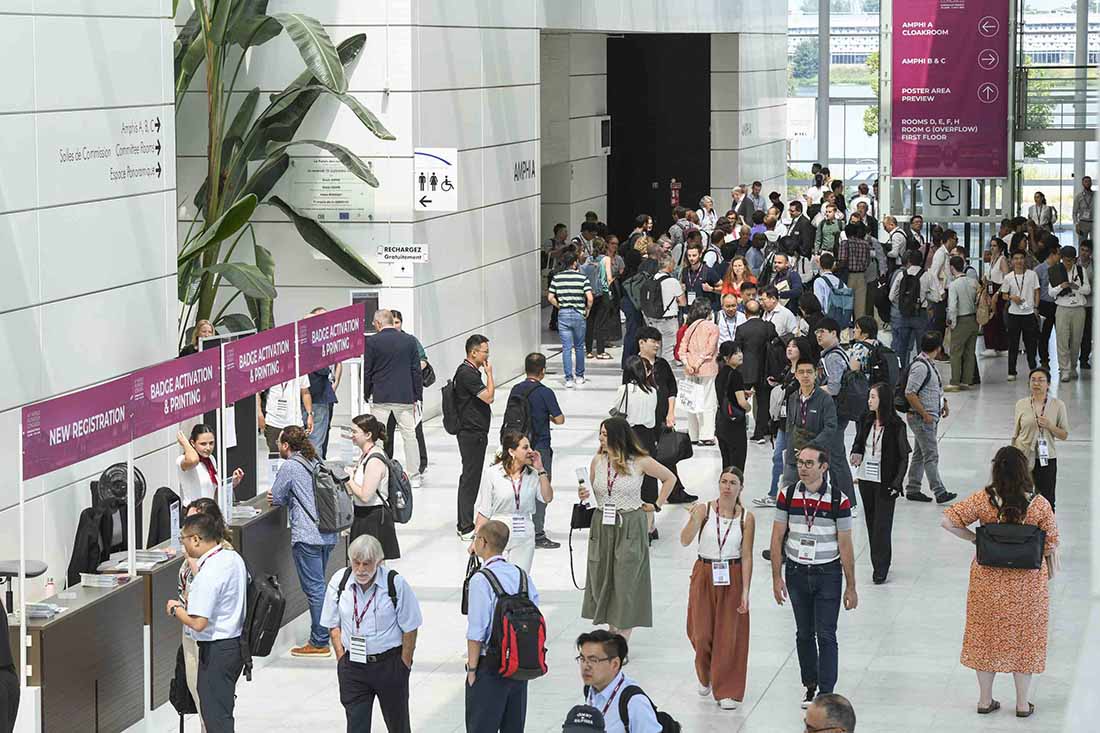
With wine-soaked Bordeaux, France serving as the host region with all it offers, the 14th edition of the World Filtration Congress held in July 2025 was well-attended by international filtration professionals, coming for WFC’s networking, education and expo.
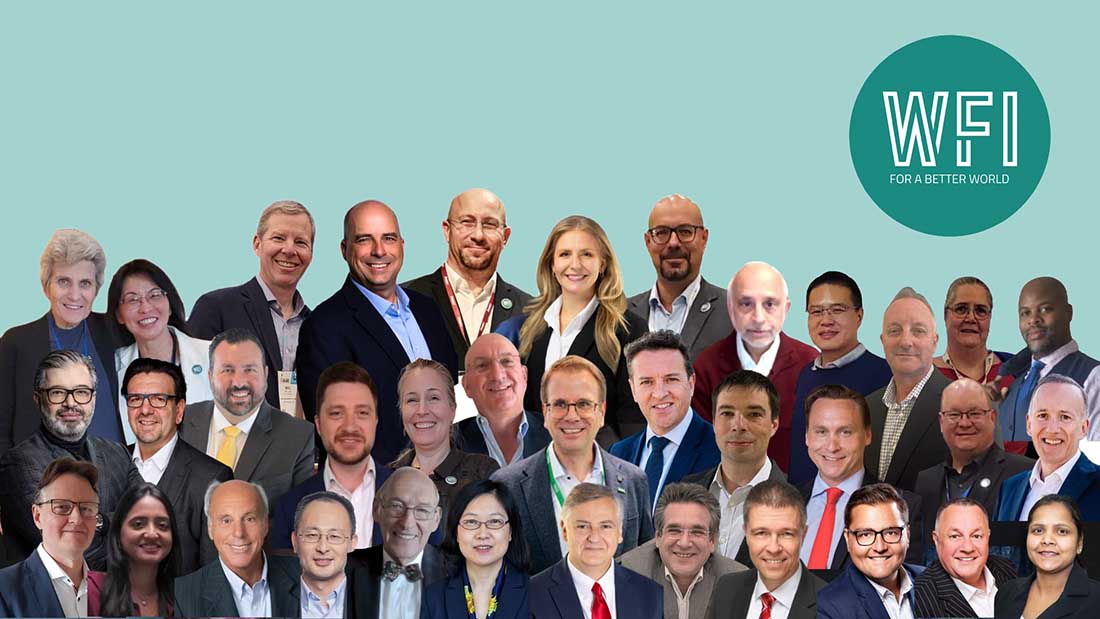
WFC14 opened with remarks from Chairman Pascal Ginisty, IFTS, and Professor Pierre-Yves Pontalier, INP, Toulouse. Members of the organizing committee followed with thoughts on the Congress, which drew approximately 700 participants from 47 countries and six continents together.
Vincent Edery, Managing Director, IFTS, set the tone for attendees, “Your presence from across continents is a powerful testament to the global importance and scientific vitality of our field. Whether you come from academia, industry, public research institutions, you are part of a community united by a common goal to push the boundaries of what filtration and separation science can achieve.
“At its core,” Edery continued, “this Congress is much more than an industry event. It is a scientific forum, a platform where fundamental research meets application and innovation, where emerging technologies are presented and challenged, and where rigorous peer-to-peer exchange helps us move the entire discipline forward. Across plenary sessions, technical presentations, posters, the exhibition and panel discussions, we witness the latest breakthroughs in material science, membrane technology, particle characterization, modeling and simulation, process optimization and much more.
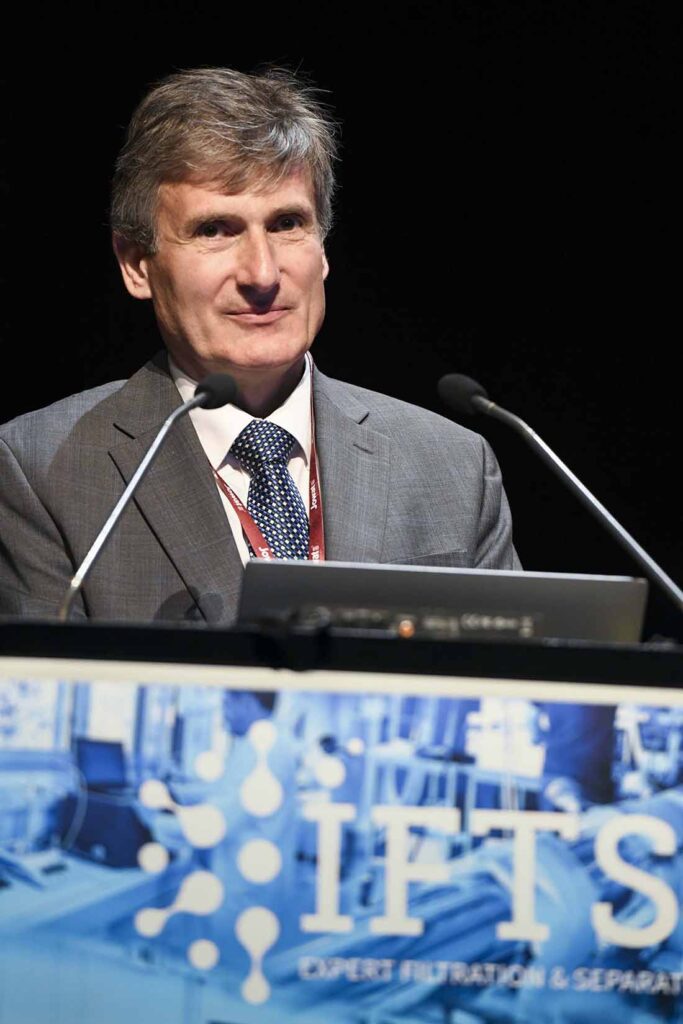
“We’re also witnessing a growing interdisciplinary convergence – where filtration research now contributes to fields as diverse as chemistry, physics, biology, data science and environmental engineering,” Edery said. “This scientific crossover is not only enriching, but essential, as the challenges we face today are complex and multi-faceted, such as clean water, clean air, efficient use of resources, environmental protection and public health. They are no longer optional goals. They are global imperatives, and they cannot be achieved without robust, reliable and constantly improving filtration solutions. That’s why research presented is not just important for our field, but for society as a whole.”
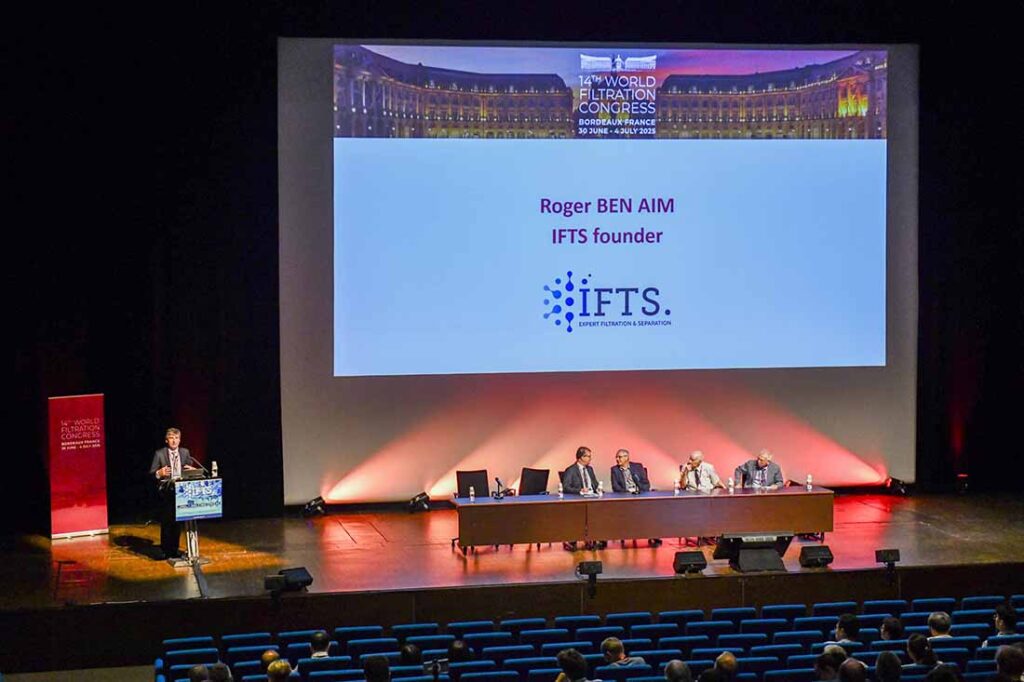
WFC14 marked 50 years since the inaugural World Filtration Congress was held in Paris in 1975. Called upon to speak as an attendee of the first Congress was Roger Ben Aim, IFTS Founder and WFC14 organizing committee member, who emphasized the power of connecting face to face in this age of digital communication. “I strongly believe that this conference is really the place for having real contact – talking and being with colleagues, which is very important, and especially in the mixing of generations. There is a growing majority of the younger generation really engaged in research activities of this field. For those researchers, they can have meaningful engagement with the elder-generation professionals. I believe that this is the main interest of the conference.”
Plenary Lecturer Herman Nirschl, from the Karlsruhe Institute of Technology (KIT), spoke on “Autonomous Processing in Separation Technologies” in the first session of the event. The focus of the work was on filtration, centrifugation, as well as mixing technology and agglomeration. The lecturer presented a deep look at technologies like digital twins and digitalization, and how it would be possible to introduce autonomous processing, not just in separation technologies, but in general for processes, emphasizing the challenges in various industries like mining, beverages, and electro-mobility.
He highlighted the use of AI and machine learning to improve process efficiency and accuracy, particularly in centrifuges and decanters. Examples included scaling up simulations from small devices to large-scale machines, using gray box models to combine white and black box models, and optimizing energy consumption. He also covered the importance of online measurement devices and control systems to achieve autonomous processes, reducing operator intervention and improving product quality.
“The goal is that we get resource and energy-efficient operations for a high product quality, and without any intervention of operators,” he said. “We have already done some parts of our processes. They are driven by computers, but it’s very hard with particle processes, because the conditions are changing all the time, and we also have distributed properties. We always have particle size distributions. We have different surfaces, different volumes and so on. We have changing properties, so how can we achieve this?” He noted, “With AI, we have a possibility to correct our computations. Now this helps us because there’s some information included which never gets into an integration.”
Plenary Lecturer Hervé Buisson spoke on “Water Filtration: Challenges and Opportunities in the Age of Sustainability.” Buisson is a globally recognized expert in water and wastewater treatment with over three decades of industry experience. He is a Manager of Veolia’s Corporate Research Centre in France and Vice-President of Process Engineering for Veolia Water Technologies Americas.
He emphasized the importance of modularity in water treatment systems to enhance durability and adaptability, especially in the face of climate change and extreme weather events. His key points included the need for robust design to handle increased storm frequency, the development of sustainable processes to minimize energy consumption and raw material use, and the integration of advanced analytical techniques for pollutant detection and removal. The challenges like disposal of disposable filters and the dewatering of waste-activated sludge were also highlighted, with a call for collaborative efforts and innovative solutions to address these and other issues.
“In sustainability, the first consideration was energy consumption, and today we are still really chasing energy,” he notes. “Energy is key for the economy of many countries, so we are still trying to minimize the energy consumption of our processes. One part of it is ‘fit for purpose.’ Do not over design the water plant that you want to do, because it will be a cost on energy. But we have to go beyond energy.”
He suggested the development of durability indexes, KPIs, and best practices to address climate change impacts on water treatment systems; the need for better integration of features to meet customer demands and to develop more sustainable solutions; the development of more sustainable filters, as well as new filtration equipment, advanced sensors, and diagnostic tools to improve plant operations and provide preventive maintenance. He also suggests the need to design filters with fewer components to facilitate recycling and addressing systems as a whole to improve water treatment efficiency and sustainability.
Finally, Buisson advocated for stronger measures, especially in choice of raw material usage to pre-qualify material availability. This will help to determine future access and cost considerations. He further stressed the need for detection of pollutants at very low concentrations, the removal of microplastics and other micro pollutants from water, deeper consideration of the positives and negatives of process choices, as well as the critical importance of collaboration between different utilities to determine the impacts of upstream processes on downstream operations.
Plenary Lecturer Kenneth Winston is a recognized expert in the sectors of Energy, Fuels, and Chemical Projects, with business development and process engineering degrees and experience. He works as a Senior Application Engineer for Calgon Carbon, part of Kuraray, a global manufacturer of chemicals, fibers, and specialty materials.
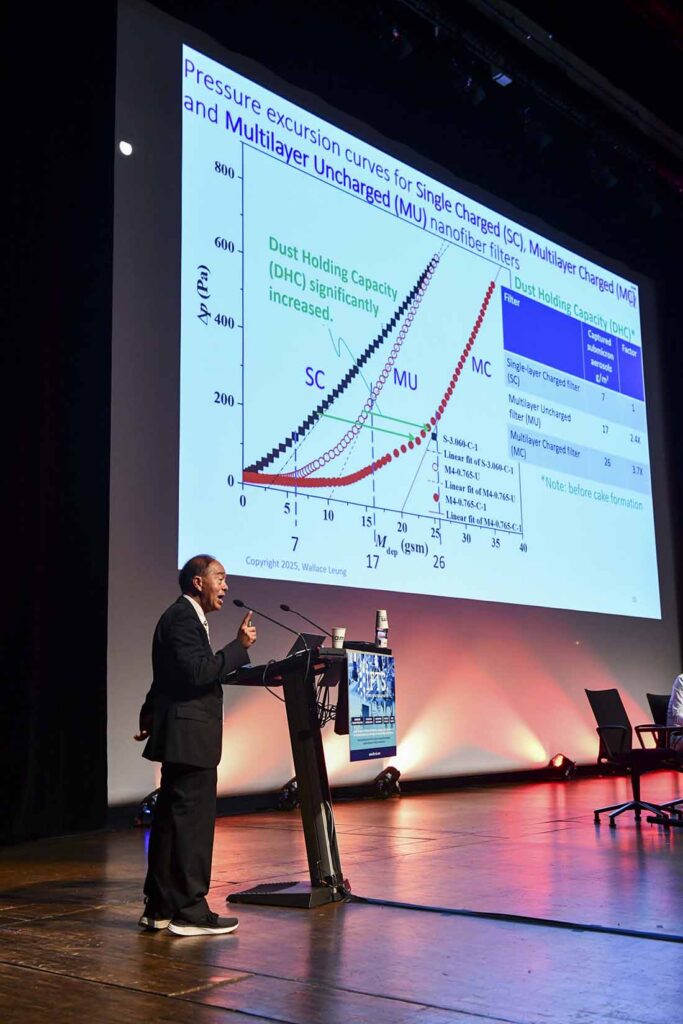
He walked attendees through the technology-drivers and current global industrial projects and investments, that include technologies for reducing and reusing carbon dioxide to green and renewable fuels and chemicals. He looked at modern gas processing innovations and technologies for carbon capture and reuse, renewable energies, green fuels and chemicals in fast-moving projects, and focused on ecological footprint investments.
He discussed the complex energy industry with the fluctuations caused by the regulatory and market impacts. The conversation also touched on the challenges of scaling up renewable fuels, such as ethanol and bio gas, and the need for research on super critical CO2 contaminants. He concluded with a focus on the potential of hydrogen, particularly for maritime and industrial applications, and the importance of continued research and policy support.
“The new commodities to watch, the new research that we need to be doing, is hydrogen, ammonia, methanol and ethanol. So let’s take a quick look at the chemical processing. In the green and blue hydrogen projects around the world – once the field levels – it will leave 355 high probability projects for green and blue hydrogen. The chemical processes industry continues on. As I mentioned, there’s ammonia and methanol. Once the project probability is calculated, we still have 89 high ammonia and methanol projects.
“The engineers working on these projects need research, data, and support,” he continued. “They can ask for equipment from the equipment vendors, but a lot of times there’s no data. All of us who design equipment regularly, we read paper after paper to try and keep up and find the data that we can to design these systems. And more than likely, we’re going to recommend a pilot unit because we don’t have good data. That raises the cost of the facility and slows implementation. Technology and data deficits are reasons that we have the low probability projects. Sometimes it’s not that we run out of money, we just don’t know how to build it yet.”
Plenary Lecturer Dr. Christine Sun, President, with Dr. Iyad Al-Attar, Strategic Director, of World Filtration Institute highlighted how filtration is fundamental to providing clean air and ensuring water quality suitable for a myriad of applications. The duo underscored the innovative solutions their organization is pioneering to tackle some of the world’s most pressing environmental challenges.
“Filtration is more than just a process; it is a cornerstone of a sustainable and healthy future,” said Dr. Sun. “From the air we breathe to the water we drink, filtration is essential to protect public health and preserve our planet’s delicate ecosystems.”
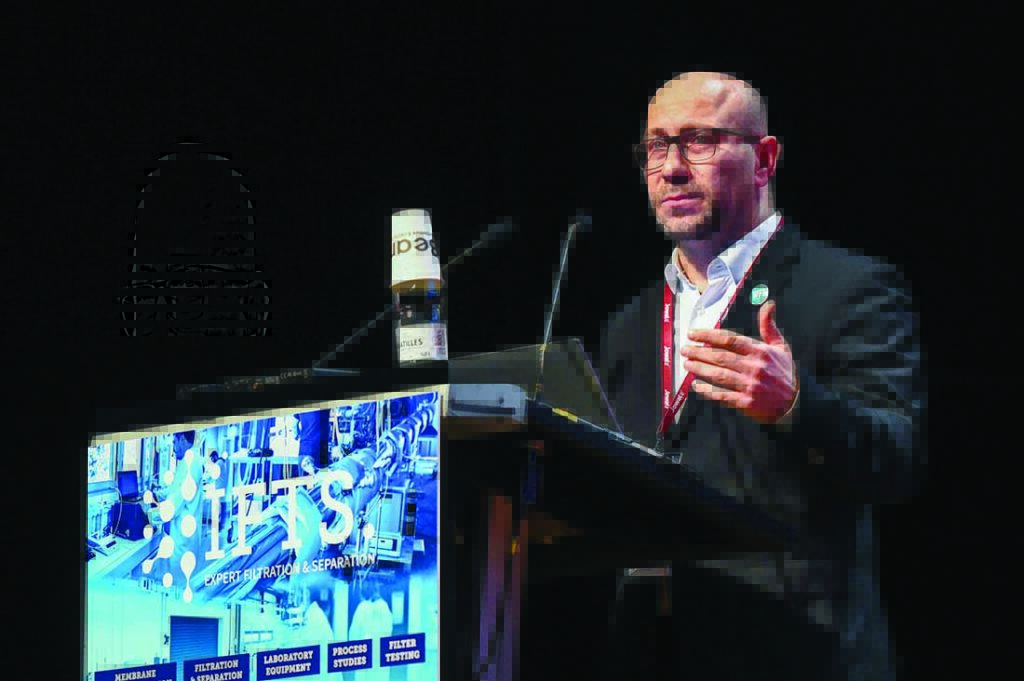
Dr. Al-Attar, also a writer for the IFN, elaborated on the strategic importance of investing in filtration research and development.
“Our work redefines the capabilities of filtration technologies while highlighting the collective responsibility we all must embrace for more sustainable, energy-efficient, and environmentally friendly living,” he stated. “By advancing the limits of what is achievable, our children and grandchildren can enjoy a planet much cleaner than the one they could inherit and dream of a sustainable future worth fighting for.”
Throughout WFC14, attendees enjoyed sessions from seven educational tracks, complete with cutting-edge research presentations, as well as networking with vendors at the WFC Exposition and special social opportunities. Look for articles from presenters of agenda sessions to be featured in future editions of the IFN.